Picture two test engineers working in the same aerospace lab. The first, Maria, is building a functional tester for an avionics controller. Her DUT expects several DC voltage and current inputs, including a few isolated channels swinging up to 40V, a couple of sourcing current channels into a sensor loop, and the ability to drop a channel as an open circuit to confirm the unit's fault diagnostics respond correctly. She doesn't need fast waveforms. She needs an isolated, repeatable, configurable V/I stimulus.
The second engineer, David, sits two benches over, and his DUT is a 32-channel embedded monitoring system that reads from thermocouples. He needs a test system to inject precise microvolt-level signals across dozens of channels at once, simulate cold-junction conditions, and replicate broken sensor wiring.
Both engineers source analog signals, both care about isolation and open-circuit simulation, but they need two different kinds of PXI modules. Maria's problem is best solved by an isolated analog output module, such as Pickering’s 41/43–770 module, while David's problem is best solved by an isolated thermocouple simulator module, such as Pickering’s 41-761A module.
Understanding why is the key to choosing the right instrument for your test system.
What Is the Pickering 41/43–770 PXI Analog Output Module?
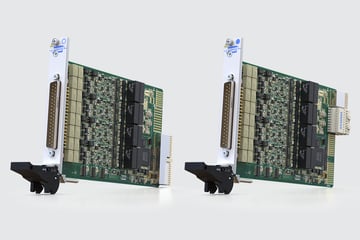 The 41–770 (PXI) and 43–770 (PXIe) are stimulus modules that provide each channel with an isolated, differential output configurable as either a voltage or current source. It's designed for test systems that need real-world electrical stimulus, channel isolation, current output, remote sensing, fault and open-circuit behavior, and long lifecycle support.
Key Features of Our AO Module
- Voltage and current source modes: Programmable voltage and programmable current output on every channel.
- Useful voltage range for functional test: ±1 V, ±2 V, ±5 V, ±10 V, ±20 V, and 0–40 V. Many other isolated analog output products stop around ±16 V.
- Current sourcing: ±5 mA, ±10 mA, and ±20 mA ranges for current-output stimulus and sensor or current-loop style applications.
- Channel isolation: Each channel is fully isolated channel-to-channel up to 200 V.
- Remote sensing: High and low sense lines per channel place the requested voltage at the DUT rather than at the module connector, making the 41/43–770 a true voltage/current source rather than a typical analog output module.
- Open-circuit simulation: Each channel can simulate open-circuit conditions, useful for wiring fault, sensor fault, and safety behavior tests.
- Hardware interlock: The interlock returns relays to their default unpowered state and can be daisy-chained between interlock-enabled modules.
- Deployment flexibility: PXI and PXIe versions, with the PXI version compatible with Pickering LXI chassis and systems.
- Long lifecycle support: A three-year warranty plus Pickering's history of supporting products for typically 15 to 20 years.
Where the 41/43–770 AO Module Fits
The 41/43-770 is primarily designed as a sensor simulator for HIL testing, generating the DC and low-speed analog signals that represent real-world sensor outputs to the DUT. It also supports broader functional test stimulus and wiring or open-circuit fault simulation, and it's the right choice when the DUT expects authentic analog sensor levels with isolation, rather than fast arbitrary waveforms. The 0–40V range, ±20 mA current sourcing, remote sense, and integrated open-circuit simulation all sit in a single PXI/PXIe slot, alongside switching and other HIL simulation modules.
The 41-761A: High-Density Thermocouple Simulator
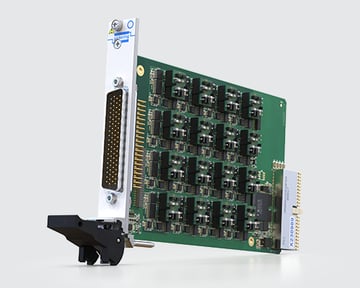 The 41-761A module is a high-channel-count PXI analog output/thermocouple simulator for low-level, isolated-voltage stimulus. It is a purpose-built low-voltage stimulus module for thermocouple simulation and adjacent low-millivolt sensor applications, where isolation, cold-junction handling, open-circuit simulation, and wiring integrity matter. It isn't a generic analog output card.
Key Features of Our Thermocouple Simulator
- High channel density: 32, 24, 16, or 8 channels in a single 3U PXI slot, delivering high thermocouple simulation density without external switching.
- Purpose-built low-voltage ranges: ±20 mV, ±50 mV, and ±100 mV in the base 41-761A-00x family, covering most thermocouple types, including B, E, J, K, N, R, S, and T.
- Extended range families: Up to ±250 mV, ±500 mV, ±1000 mV, ±1500 mV, and ±2000 mV, depending on order code, to enable support for higher voltage sensor types, such as pressure transducers.
- Fine resolution: 0.7 µV nominal on the ±20 mV range, 1.7 µV on ±50 mV, and 3.3 µV on ±100 mV.
- Two-wire isolated output: Independent V- connections per channel suit DUTs with multiple cold junctions or common-mode voltages.
- Open-circuit simulation: Per-channel fault simulation for wiring and sensor faults.
- Channel isolation: 100V channel-to-channel and channel-to-ground.
- Faster operation: 85 µs typical in fixed range and 550 µs typical in auto range, improving test sequencing throughput over the original 41–761.
- Thermocouple-specific accessories: Compensation block, calibration cable, and copper twisted-pair thermocouple plug cables.
Where the 41-761A Thermocouple Simulator Fits
The module suits HIL and controller validation for temperature inputs, production, and functional test of temperature-measurement electronics, and isolated millivolt-to-low-volt stimulus beyond thermocouples. It's a strong fit where temperature inputs are safety-relevant and require fault cases, channel isolation, and repeatable automated sequencing. The high channel density makes it valuable for testing multiple DUTs simultaneously or for multi-channel data acquisition in industrial control, aerospace, defense, or environmental control systems.
Specifications Compared
| Specification | 41/43–770 analog output module | 41-761A high-density thermocouple simulator |
|---|---|---|
| Architecture | Isolated DAC-based voltage/current source. Differential output | Isolated two-wire low-voltage analog output/thermocouple simulator |
| Primary application | Isolated V/I stimulus, HIL, fault simulation | HIL, thermocouple and low-millivolt sensor simulation |
| Channels | 4 or 2 in one 3U slot | 32, 24, 16, or 8 in one 3U slot |
| Bus / format | 41–770: PXI. 43–770: PXIe (PXI also fits Pickering LXI Chassis) | PXI only (also fits PXIe hybrid slots and Pickering LXI) |
| Resolution | 16 bits for all ranges | From 0.7 µV (±20 mV range), to 66 µV (±2000 mV range) |
| Voltage ranges | ±1 V, ±2 V, ±5 V, ±10 V, ±20 V, 0–40 V | ±20 mV to ±2000 mV depending on variants |
| Current ranges | ±5 mA, ±10 mA, ±20 mA | Not applicable |
| Accuracy | Range dependent (e.g., ±1 V: ±[(0.05% + 0.005%/°C) of setting + (1.8 mV + 0.12 mV/°C)]) | Range dependent (e.g., ±20 mV: 0.1% ±5 µV) |
| Isolation | 200 V, channel-to-channel and channel-to-ground | 100 V, channel-to-channel and channel-to-ground |
| Remote sense | High and low sense lines per channel | Two-wire output with independent voltage per channel |
| Operation / settling | 250 µs typical fixed range. 4 ms typical auto range | 85 µs typical fixed range. 550 μs typical auto range |
| Open-circuit simulation | Per channel | Per channel |
| Hardware interlock | Yes, daisy-chainable | Not applicable |
| Drivers / software | IVI and VISA drivers. LabVIEW, C/C++, C#, Python. LabVIEW RT | IVI and VISA drivers. LabVIEW, C/C++, C#, Python. LabVIEW RT |
| Warranty | 3 years, with guaranteed long-term support | 3 years, with guaranteed long-term support |
Choosing the Right Module
The two modules solve different signal-sourcing problems:
Choose the 41/43–770 when you need an isolated voltage or current stimulus across a wide range, including 0–40 V, ±20 mA current sourcing, and remote sense. It's the better fit for HIL, functional test stimulus, and wiring-fault simulation, where channel count is modest but voltage range, current output, and isolation matter. PXIe availability and Pickering LXI compatibility add deployment flexibility.
Choose the 41-761A when you need a high-density, low-microvolt thermocouple or low-millivolt sensor simulation. With up to 32 isolated channels per slot, fine µV-level resolution, cold-junction support, and open-circuit fault states, it's purpose-built for temperature-input validation and production test of temperature-measurement electronics.
Both modules share industry-standard PXI form factor, broad driver support, and guaranteed long-term support, with a three-year warranty standard and a typical product lifecycle of 15–20 years. That longevity helps reduce the risk of obsolescence in long-life test systems across aerospace, defense, automotive, and industrial applications.
How the 41/43–770 Compares to Other Analog Outputs
The closest direct alternative for the 41/43-770 module is the NI PXIe-4322, an 8-channel isolated PXIe analog output module with voltage and current modes. The Keysight M9186A is an adjacent V/I source competitor, stronger for a single high-voltage or higher-current channel, but with lower density and occupying two PXI slots.
| Pickering 41/43–770 | NI PXIe-4322 | Keysight M9186A | |
|---|---|---|---|
| Top-line specs | Isolated, multi-channel DC/low-speed V/I stimulus with open-circuit simulation | High-speed, isolated, 8-channel dynamic V/I analog output | Single-channel, isolated high-voltage/current V/I source |
| Channels / slots | 2 or 4 channels in 1 slot | 8 channels in 1 slot | 1 channel in two slots |
| Bus / Form Factor | PXI or PXIe (PXI also fits Pickering LXI Chassis) | PXIe only | PXI only |
| Resolution | 16-bit | 16-bit | 16-bit |
| Voltage output | ±1, ±2, ±5, ±10, ±20 V, 0–40 V | Nominal ±16 V | Low range ±16V, high range -10V to +100V |
| Current output | ±5, ±10, ±20 mA | Nominal mA current mode | Up to ±200 mA low range, 20 mA high range |
| Speed / settling | 250 µs typical fixed-range settling | 250 kS/s per channel, ~20 µs settling | Not positioned as dynamic AO |
| Open-circuit / interlock | Open-circuit simulation per channel, daisy-chainable hardware interlock | High-impedance power-off state, no open-circuit positioning | Safety interlock for high-voltage amplifier |
| Warranty | 3 years standard | 1 year standard | 1 year standard |
| Estimated Price Point | $4,615* (4-channel) $3,430) (2-channel) |
$5,476* | $6,515* |
* Price at time of publication
When you need multiple isolated channels of higher voltage and higher current stimulus in a single PXI/PXIe slot, the 41/43–770 stands apart. It delivers a 0–40V range, integrated open-circuit simulation, and the flexibility to deploy across both PXI and LXI chassis, all at a lower price per module than the comparable Keysight option for multiple isolated outputs.
It's worth being clear about where the alternatives lead. The NI PXIe-4322 is the faster card for dynamic analog output and offers a higher 300 Vrms CAT II isolation rating, so if raw speed or isolation rating are your deciding factors, that's the module to consider. The Keysight M9186A is the right choice when you need a single-channel source capable of 100V and 200 mA.
Outside of those specific cases, the 41/43–770 is the module to reach for: isolated, higher-voltage and current stimulus across multiple channels, packed into one slot, and ready for either PXI or LXI deployment.
How the 41–761A Compares to Other Thermocouple Simulators
Use this table to evaluate the Pickering 41-761A against four practical alternatives you're most likely to encounter when specifying a thermocouple simulation solution for automated test or HIL applications: the Bloomy Thermocouple Simulator Module for SLSC, the Highland Technology Model P470, and the UEI/Ametek DNx-TC-378.
| Specification | Pickering Interfaces 41-761A | Bloomy Thermocouple Simulator for SLSC | Highland Technology Model P470 | UEI/Ametek DNx-TC-378 |
|---|---|---|---|---|
| Channel Count | 8, 16, 24, or 32 channels in a single 3U PXI slot | 8 channels | 8 channels | 8 channels |
| Thermocouple Types Supported | All major types including B, E, J, K, N, R, S, and T | E, J, K, M, N, T | J, K, E, T, R, S, B, N | All common types via ±100 mV range |
| Accuracy and Resolution | 0.7 µV resolution (±20 mV range). 1.7 µV (±50 mV range). 3.3 µV (±100 mV range). Calibration data stored in on-board EEPROM | Not Specified. High-precision DACs used | 20-bit resolution in voltage mode. ±100 mV output range | 16-bit resolution. 3.8 µV resolution (Type K). 0.6°C accuracy (Type K, including CJC) |
| Output Range | ±20 mV, ±50 mV, ±100 mV (thermocouple ranges). Extended to ±2,000 mV as standard | ±100 mV | ±100 mV (voltage mode) | ±100 mV |
| Channel Isolation | 100V channel-to-channel and channel-to-ground. Correct common-mode voltage handling | ±60V channel-to-channel and channel-to-ground | Full channel-to-channel isolation. Damage protection up to 240V RMS | Full channel-to-channel isolation. |
| Open-Circuit Simulation | Yes, per channel | Yes, per channel | Yes, per channel | Yes, per channel |
| Cold Junction Compensation | Optional cold junction compensation block. Independent V⁻ connections per channel | On-board and remote CJC via external thermistors | Internal RTD sensor plus two external RTD sensor inputs. Any channel can reference any junction | Three fully isolated CJ input channels |
| Update Rate | 85 µs typical (fixed range). 550 µs typical (auto range) | [Not Specified] | [Not Specified] | 1 kHz per channel max (1,024-sample FIFO. 8 KHz aggregate) |
| Form Factor | PXI. Compatible with PXI, PXI Express legacy/hybrid slots, and Pickering LXI/USB modular chassis | SLSC module. Requires NI PXI reconfigurable I/O module with minimum 32 digital outputs | Benchtop standalone instrument | Modular I/O board for Cube, RACKtangle, or FLATRACK chassis |
| Interface / Connectivity | PXI backplane. 78-pin D-type front connector | HD44F connector. NI SLSC interface | Ethernet and USB | DB37 connector. Screw terminal panel available |
| Software Compatibility / Drivers | VISA, IVI, and Kernel drivers for Windows. LabVIEW, Python, C/C++, MATLAB/Simulink, and others supported. VeriStand custom device available on request | VeriStand custom device. Dependent on NI PXI ecosystem | ASCII serial command set and built-in web interface. | Windows, Linux, QNX, VxWorks, and most popular RTOSes. LabVIEW and MATLAB via UEIDAQ Framework |
Note on product equivalence: The products in this table represent a range of form factors and deployment architectures, from modular PXI and proprietary chassis boards to standalone benchtop instruments. Not all are direct architectural equivalents to the 41-761A. The Bloomy SLSC module and UEI/Ametek DNx-TC-378 are the closest functional alternatives, offering isolated multi-channel thermocouple simulation in modular form factors. At the same time, the Highland Technology P470 is a benchtop instrument suited to lab or system-level calibration workflows. The 41-761A's primary competitive advantage is its combination of up to 32 independently isolated simulation channels in a single PXI slot, µV-level resolution, true sensor-level output behavior with common-mode voltage handling, and seamless integration into automated test and HIL architectures alongside Pickering's broader signal-path ecosystem.
Conclusion
Choosing between the 41/43–770 and the 41-761A comes down to the nature of your stimulus requirements. If, like Maria, your test system needs isolated voltage and current output across a wide range, including levels up to 40 V, current sourcing, and remote sense, the 41/43–770 is the right fit. If you're validating temperature-input electronics and need high-density, µV-level thermocouple simulation across up to 32 isolated channels like David, the 41-761A is the right, purpose-built solution. Both modules reflect Pickering's approach to test: precise, application-specific PXI/PXIe simulation hardware that integrates cleanly into a complete signal path and stays supported for the life of your test system.
To discuss your specific application with a Pickering engineer, contact us directly at pickeringtest.com/contact.
Frequently Asked Questions
Is the 41/43–770 an arbitrary waveform generator?
No. The 41/43–770 is a programmable isolated V/I source for static or low-speed DC stimulus, not an AWG or function generator. For multi-channel waveform or function generation, consider the Pickering 41/43–625 series, which supports waveform generation from DC to 300 kHz across up to 32 channels.
Can the 41/43–770 simulate 4–20 mA current loops?
The module sources current up to ±20 mA, so it fits some current-output stimulus cases. If the application is specifically an industrial 4–20 mA loop simulation, also consider the Pickering 41/43–765, which is purpose-built for current-loop simulation.
Is the 41/43–770 a source-measure unit (SMU)?
No. The 41/43–770 sources voltage and current, but isn't positioned as a precision source-measure instrument. If you need four-quadrant precision measurement, leakage measurement, or semiconductor-style characterization, an SMU is the appropriate instrument.
What is the difference between the 41-761A and the 41–761?
The 41-761A offers an extended voltage range of ±2000 mV compared to the 41–761's ±100 mV. It was also designed for customers requiring a faster output for real-time hardware-in-the-loop applications.
Can the 41-761A be used for battery simulation?
No, it’s not designed to sink current in the same manner as, say, the 41/43-752A, which is purposefully designed to simulate batteries.
Is the 41-761A compatible with LXI?
Yes, the 41-761A is a PXI module. For LXI compatibility, you can host the module in any of our LXI/USB Modular Chassis.
Will the 41/43–770 work in an NI-based test system?
Yes. Pickering PXI and PXIe modules are routinely used in NI-based test systems. The 41/43–770 includes LabVIEW, C/C++, C#, and Python drivers and sits alongside NI instrumentation, while Pickering handles the signal-path, isolation, switching, and cabling.
How long will the 41/43–770 be supported?
Every 41/43–770 module ships with a three-year warranty, and Pickering has a history of supporting products for typically 15 to 20 years, making it suitable for production, aerospace, defense, and other long-life test systems.
RELATED RESOURCES: