Ask any test engineer what keeps them up at night, and you’ll rarely hear complaints about the switching matrix. That’s the issue. The matrix quietly sits at the heart of your automated test system, routing signals between instruments and devices under test, until the day it can’t scale, can’t route a signal cleanly, or fails mid-production without a clear indication of which relay went down. Suddenly, the component nobody paid attention to becomes the reason a test system slows down, falsely fails good products, or worse, grinds to a halt.
At Pickering, we know that switch matrices deserve far more strategic attention than they usually get. As devices become more complex and pin counts multiply, the wrong matrix architecture can force expensive redesigns, degrade measurement accuracy, and turn simple maintenance into a headache. The right architecture does the opposite. It scales to meet demand, ensures signal integrity in high-density configurations, and provides clear visibility into relay health to prevent unexpected failures.
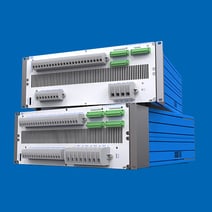
That’s why we designed our high-density LXI modular matrix to deliver exactly this kind of reliability and scalability. It scales from 64x8 to 384x8 using modular plug-in architecture. Let’s dig into why matrix decisions matter more than most engineers assume, and where the wrong approach can hold your team back.
The Scalability Trap: When Growth Becomes a Bottleneck
Most test systems start small. A project might require a modest matrix, budgets are tight, and teams often specify a fixed-size solution to meet immediate needs. It seems like a cost-effective decision until the next product arrives with double the pin count or parallel testing becomes a requirement. Suddenly, the fixed matrix hits its ceiling.
At that point, you’re stuck with two options: rip out the current switching infrastructure and start over, or bolt on a second system and deal with the integration hassle. Both choices are expensive, time-consuming, and disruptive to validated processes.
Our modular approach changes everything. With our scalable matrices, you can expand capacity incrementally as your needs grow, avoiding costly overhauls. Here’s how it works:
- The 2U chassis houses up to six plug-in modules, each providing a 64x8 sub-matrix.
- Start with what you need, scaling the X-axis up to 384 in increments of 64.
- Switched Y-axis loop-thru connections make it easy to expand the matrix into a second chassis.
- Field upgrades are simple… just add a module through the front panel without replacing the entire system.

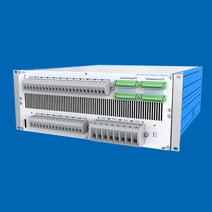
Figure 1: 65-217 Modular Matrix with six plug-ins
This design aligns your spending with your production demands. Instead of replacing outdated systems every few years, you can protect your initial investment and grow as needed. For teams under tight budgets and constant scrutiny, this approach is far easier to justify.
Signal Integrity in High-Density Matrices
Scalability doesn’t mean much if your signals degrade along the way. Large switching matrices, such as our 384x8 model, integrate thousands of crosspoints into a single system, introducing risks such as crosstalk and capacitance buildup. These issues can compromise measurement accuracy, especially in sensitive analog applications.
We prioritize signal integrity in every design to ensure what goes into the matrix comes out cleanly. The 65–217 achieves this through a layered isolation process:
- Sub-matrix isolation: Each 64x8 plug-in is divided into eight 8x8 sub-matrices, with dedicated isolation relays for each. Unused paths disconnect entirely, reducing interference.
- Lower capacitance: Removing idle paths minimizes capacitance, preserving bandwidth and maximizing signal integrity.
- Backplane bus isolation: Plug-ins can connect to one of two analog buses or disconnect entirely, so unused modules don’t load the active bus.

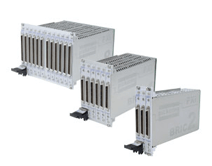
Figure 2: 65-217 64x8 Plug-in
These features result in excellent RF performance for a matrix of this density. Crosstalk is as low as -65 dB at 10 kHz, with isolation of 80 dB across much of the usable band. For engineers working with demanding analog hardware, this level of performance ensures trustworthy data without second-guessing.
Minimizing Downtime with Predictive Maintenance
In production environments, a failed relay doesn’t just delay a test… it halts the line entirely. Without built-in diagnostics, finding a failed relay among hundreds or thousands of crosspoints can be a long and manual process. That kind of downtime isn’t just frustrating, it’s expensive.
We’ve built predictive maintenance directly into the 65–217 to minimize unplanned downtime and extend system life:
- Relay cycle counting: Each module tracks the number of operations for every contact. This data lets you replace relays before they fail or redistribute heavily used contacts to extend their lifespan.
- Built-In Relay Self-Test (BIRST): Integrated diagnostics indicate faulty relays without external equipment. Disconnect the device under test, attach loop-back connectors, and run the test.
- eBIRST tools: For pinpoint fault isolation, our external eBIRST tools identify the exact faulty relay and display it graphically. They also highlight relays with increased contact resistance, indicating they are approaching end-of-life.
By shifting maintenance from reactive to predictive, you can schedule relay replacements during planned downtime, preventing failures mid-run. Combined with our three-year warranty and typical 15 to 20-year product support, our matrices are designed to maximize uptime and reduce repair costs.
Standardization Over Proprietary Control
Legacy systems built on proprietary control protocols can be a nightmare to integrate, modernize, or scale. They resist interoperability, limit remote testing, and eventually force upgrades on the vendor’s terms.
We’ve built the 65–217 to be fully compliant with the LXI standard. It uses a 1000Base-T Ethernet interface, giving you key advantages:
- Remote control over Ethernet makes distributed test systems easy to implement.
- Interoperability with third-party instruments eliminates the risk of vendor lock-in.
- Broad software support for environments like LabVIEW, Python, MATLAB, and more.
This open standard future-proofs your investment and simplifies integration with your existing tools, avoiding the pitfalls of proprietary systems.
Unlocking Throughput with Parallel Testing
High-density matrices like the 65–217 don’t just save space, they also boost efficiency. With dual analog buses, you can configure the system to support parallel testing without duplicating hardware. Options include:
- Two independent matrices: Separate some plug-ins onto one bus and others onto a second for testing two devices at once.
- One large matrix: Combine all plug-ins into a 384x8 configuration for maximum capacity.
- Standalone switching: Use individual plug-ins independently by disconnecting from both buses.

Figure 3: On the left, the schematic of a single 64x8 plug-in, and on the right, the schematic of
a 65-217 chassis configured as a 256x8 matrix with 4 plug-ins and 2 analog buses
The integrated scan-list feature can store up to 5,000 S/W and H/W-triggered test sequences, reducing control transactions and system latency. This means higher throughput from the same hardware—an easy way to improve ROI on your test system.
The Matrix Decision Shapes Your Test System’s Future
The switching matrix is one of the most overlooked components in automated test systems, but its impact on scalability, signal integrity, downtime, and throughput can’t be ignored. Choosing a high-density, modular matrix architecture like the 65–217 isn’t just about solving today’s problems—it’s about building a system that serves you reliably for the next 15 to 20 years.
If you’re designing a new test system, replacing outdated hardware, or scaling up without a full rebuild, we’d be happy to help. Download the 65–217 technical datasheet or schedule a consultation with your local Pickering engineer to see how our modular high-density architecture can fit your specific needs.