I've spent a good part of my career staring at the back of test racks, schematic in hand, verifying cables run to the right instrument and to the test interface. Then, double-checking that the sense lines from a myriad of power supplies follow the associated main output lines to their destination. If you've built automated test equipment for any application, including power electronics, batteries, or solar inverters, you already know the feeling. Incorrect routing of the most basic signals, PSU high current, and complementary sense lines can be where many test programs & engineers quietly lose time, accuracy, and sleep.
This article is the version of advice I wish someone had given me earlier. I'll walk through why high current and sense switching matter, where test cycles bog down, how the 60–191 LXI High Current & Sense Switching Units resolve those bottlenecks, and why an LXI-based approach helps future-proof the systems we build.
Why High Current and Sense Switching Matters
Modern test environments rarely test one thing at one single level. A single bench might validate a battery management system at 40 A, then characterize a DC-DC converter that pulls 80 A, then move on to a low-power standby measurement that needs microvolt accuracy. However, the hard part isn't sourcing the power; it's routing it cleanly to the right device under test (DUT) and then measuring what's actually happening.
Two problems dominate.
- Safely switching high current paths. Mechanical relays rated for signal-level work simply aren't built to repeatedly make or break tens of amps. Use the wrong relay, and you get contact welding, arcing, and unpredictable failures that appear as inconsistent test results long before they turn into a dead relay.
- Preserving measurement accuracy through sense lines. All signal paths, especially high-current ones, develop voltage drops across cables, connectors, and contacts. Four-wire (Kelvin) sensing solves this by routing separate high- and low-sense lines directly to the DUT, so the power supply regulates at the load rather than at its own terminals. But that only works if your switching system routes sense lines as carefully as it routes power. Mix them up, or switch them with noisy relays, and your accuracy evaporates.
When you get both right, everything downstream improves, with cleaner data, fewer retests, and a test system you can trust.
The Bottlenecks Nobody Budgets For
The pain in high-current test work tends to cluster around the same recurring issues. I've watched validation engineers, integration engineers, automation engineers, and R&D test managers all hit these from different angles.
- Test setup complexity. By the time you've wired contactors, added a control board, documented the harness, and labeled every cable, you've built a one-off that nobody else can maintain, and will be a challenge to replicate should testing requirements expand over time.
- Slow test sequences. If switching is controlled by ad hoc relay logic, every state change has a software overhead. Across thousands of cycles, that latency adds up and stretches your test window, reducing your test system throughput.
- Maintenance surprises. Relays wear out; it's a simple fact that two pieces of metal opening and closing will eventually degrade. The question is whether you find out during scheduled maintenance or during a production run. Without cycle data, you're guessing.
- Rack sprawl. Multiple power supplies, each with positive, negative, and sense connections, quickly consume cabinet space. Consolidating those paths into one managed footprint is harder than it sounds.
- Mixed current levels. Few systems need only one current class. You usually want a couple of high-current paths and several medium ones, all in the same chassis and centrally controlled.
These bottlenecks are where I started looking for a purpose-built solution rather than another custom build.
How the High Current Switching Resolves Bottlenecks
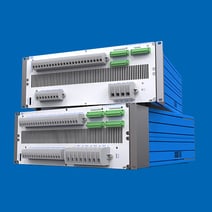
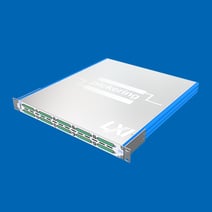
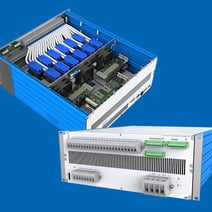
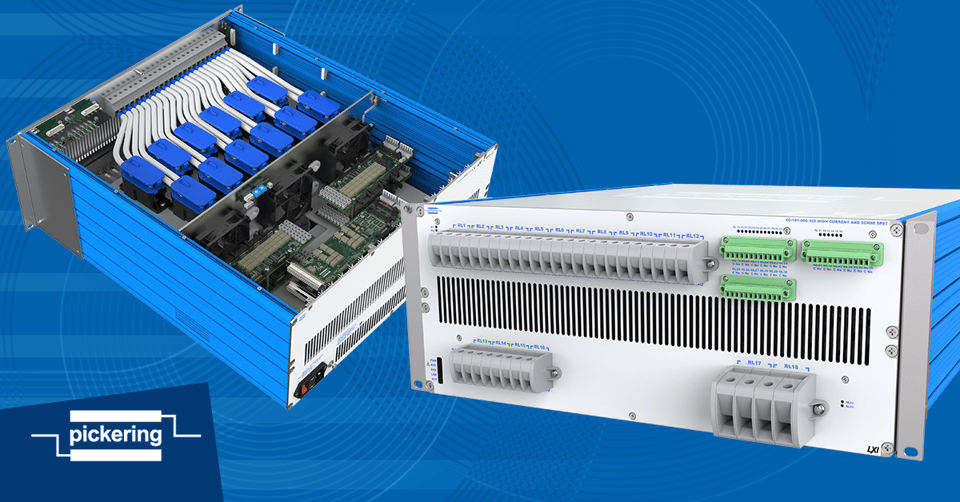
The 60–191 is a 4U rackmount switching family compliant to LXI Standard, controlled via 1000Base-T Ethernet. That single line already addresses two of my biggest frustrations. It drops straight into a standard rack as a preconfigured solution and talks to my test controller over plain Gigabit Ethernet, with all the advantages it offers, rather than a proprietary link.
Here's what it does. The family is built to switch the positive and negative outputs of up to two 80 A maximum power supplies and/or up to ten 40 A maximum power supplies, along with the corresponding high- and low-sense lines. In switch terms, that's up to four 80 A switches and twenty 40 A switches, plus complementary low-current sense relays. So, I can centralize the distribution, management, and isolation of multiple PSUs in a single chassis, rather than scattering switches throughout a system.
The high-current switching uses hermetically sealed SPST-NO contactors, hot-switch rated for currents up to 300 V. Hermetic sealing matters because it keeps the contact environment stable, which is exactly what you want when you're hot-switching power levels associated with 80A and need predictable behavior cycle after cycle.
For programming optimization, relays can be operated in groups, including PSU positive, PSU negative, Sense Hi, and Sense Lo simultaneously. That means I can connect or disconnect a complete four-wire path to a DUT with a single logical action, instead of toggling four relays and hoping that the correct four switches were selected. Alternatively, if required, I can still control each relay independently. That flexibility is the difference between readable test code and a maintenance headache.
On speed, the units include built-in scan-list sequence stores with hardware- and software-triggered support. I can load a sequence once and let hardware triggers step through it, removing the per-step software latency from the loop. For long characterization runs, this can reduce communication overhead and improve sequence efficiency.
For the maintenance side, the 60–191 provides LED relay indication and relay cycle counting. The LEDs give me an immediate visual of the switch state when I'm at the rack. Cycle counting turns relay wear from a surprise into a planned maintenance item, which is exactly what a risk-averse program needs.
Integration is handled through IVI and direct I/O drivers, so it fits whether your framework expects standardized IVI behavior or you prefer to talk to the hardware directly. And the family benefits from a 3-year warranty as standard, along with Pickering’s reputation for sustainable obsolescence management, which speaks to the expected service life in continuous testing use.
Where This Plays Out in the Field
Automotive and e-mobility. Battery and inverter testing demands both high-current paths and trustworthy sense measurements. Grouping PSU and sense relays lets me reconfigure between test stages, confident that signal routing is always accurate, without error-prone manual rewiring or individual relay selection. Hermetically sealed contactors handle the repeated hot switching required for EV component validation.
Alternative energy and solar. Inverter and power-conditioning testing often involves several supplies and varied current levels. Consolidating up to ten 40 A supplies, or mixing in 80 A paths, into one managed 4U chassis keeps the test station compact and the wiring centralized.
Laboratory and R&D. Bench environments change constantly. The combination of central PSU management, supply isolation, and an Ethernet control interface means I can repurpose a station for the next project with minimal effort or downtime.
Futureproofing with an LXI Architecture
An LXI Standard 1.5 instrument communicates over standard Ethernet, so it integrates with the controllers and networks you already run, and it scales as you add stations. There's no proprietary control interface that could become obsolete. When a project ends, the same 60–191 carries forward into the next one with new scan lists and grouping rather than new hardware.
For a manager weighing cost against risk, that's the point. You buy switching infrastructure once, document it once, and reuse it across programs. Cycle counting and LED indication keep maintenance predictable. The 3-year warranty backs the service life. That's how a high-current switching investment stays cost-effective and applicable over the long haul.
Conclusion
The lesson from the back of the rack is simple, high-current switching and sense routing aren't two problems, they're one coordinated signal path. Design them together, control them centrally, and you cut wiring complexity, eliminate mismatched switching states, and turn maintenance from a surprise into a scheduled task. You also build a test system that your team can reuse across programs.
If your test program routes serious current and still demands trustworthy measurements, the 60–191 LXI High Current Switching Units are the purpose-built solution I'd reach for. It switches up to four 80 A and twenty 40 A paths through hermetically sealed contactors, hot-switches rated currents up to 300 V, and counts every relay cycle so preventative maintenance stays predictable. For automotive, solar, and R&D work, where power supply routing directly affects test accuracy and cycle time, that combination solves the exact problems I've spent years untangling at the back of the rack, and it changes how you design test systems for reliability and reuse.
Frequently Asked Questions
What are the 60–191 LXI units used for?
It switches the positive and negative outputs of high-current power supplies, up to two 80 A or ten 40 A units, along with their high and low sense lines, in a single 4U rackmount chassis, controlled over Ethernet.
How does it preserve measurement accuracy?
It routes dedicated high- and low-sense relays alongside the power paths, supporting four-wire Kelvin sensing so the supply regulates the voltage at the DUT rather than at its own terminals.
Can I simplify programming?
Yes. Relays group logically into PSU positive, PSU negative, Sense Hi, and Sense Lo, so you can switch a complete four-wire path in a single action or control each relay independently when needed.
How does it speed up test sequences?
Built-in scan list sequence storage, with hardware- and software-triggered loading, lets you load a sequence once and step through it without per-step software latency.
How do I plan maintenance?
Relay cycle counting and LED relay indication let you track wear and verify switch state, turning relay replacements into scheduled maintenance rather than unplanned downtime.